
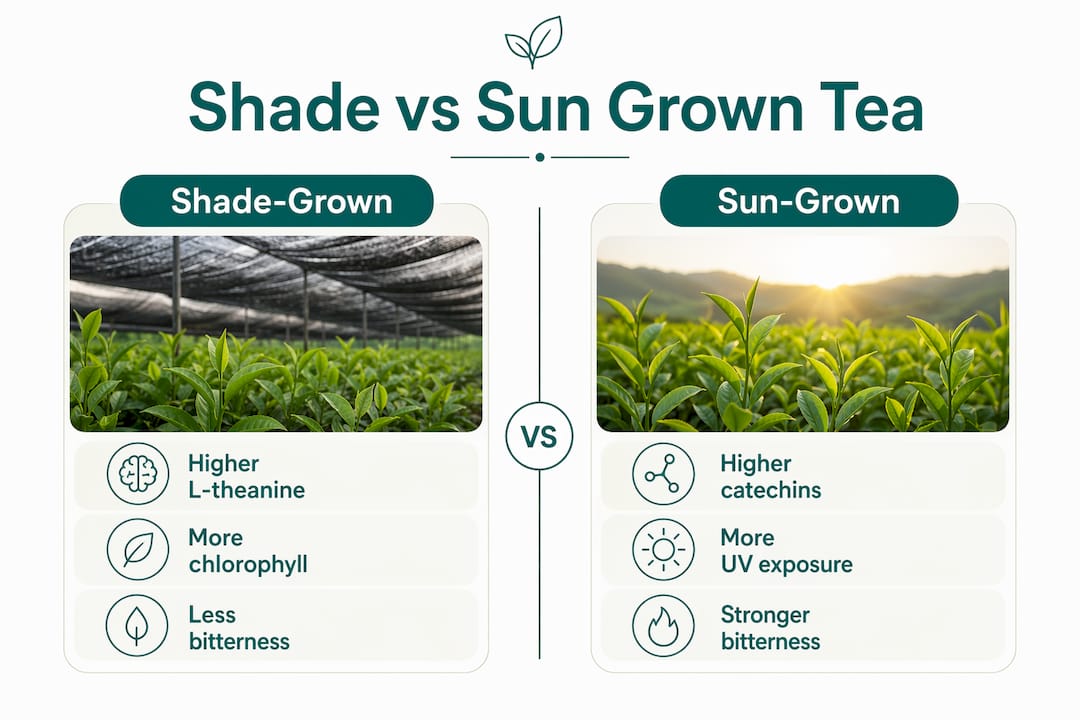
Shade-grown tea is defined as tea produced from plants covered for 20–35 days before harvest, blocking 70–95% of sunlight to trigger a precise shift in leaf chemistry. The role of shade grown tea benefits goes far beyond flavor. Shading increases L-theanine by 50–100%, reduces bitter catechins by 20–40%, and spikes chlorophyll levels dramatically. The result is a cup that is sweeter, calmer, and richer in health-supporting compounds than most teas you will find on a shelf. Gyokuro and Matcha are the most recognized examples, and both owe their distinctive character entirely to this cultivation method.
How does shading change tea leaf chemistry?
Shade-grown tea’s health advantages begin at the biochemical level. When tea plants are covered, UV radiation drops sharply, and the plant responds by rerouting its metabolic resources. Less sunlight means less photosynthesis, so the plant compensates by producing more chlorophyll and accumulating amino acids instead of converting them into catechins.
The key compound here is L-theanine. Shading causes L-theanine levels to rise 50–100% compared to sun-grown tea. Some premium Gyokuro and Matcha leaves reach L-theanine concentrations 3–5 times higher than their sun-grown counterparts. That concentration is what gives shade-grown tea its signature calm, focused energy.
Catechins tell the other half of the story. These polyphenols are responsible for the astringent, bitter bite in most green teas. Shading suppresses the phenylpropanoid pathway enzyme PAL, which cuts catechin synthesis by 20–40%. Less bitterness does not mean fewer antioxidants, though. EGCG and other catechins remain present in sufficient quantities to preserve a strong antioxidant profile.
Chlorophyll production also surges under shade conditions. The plant widens its light-capturing structures and deepens its green pigment to absorb every available photon. That deeper green color you see in ceremonial Matcha is a direct indicator of elevated chlorophyll content, not just aesthetics.
Pro Tip: When buying Matcha or Gyokuro, look for a vivid, deep green color. Pale or yellowish leaves signal less shading time and lower L-theanine and chlorophyll levels.
The two-stage shading method
Advanced producers use a two-stage shading approach: a moderate shade period of 15–20 days followed by an intense final shade of 5–10 days just before harvest. This sequence maximizes both L-theanine and chlorophyll in the youngest, most tender leaves. The result is measurably higher compound concentrations compared to single-stage shading. Producers who skip the final intense stage typically yield a less complex flavor and a lighter green color.
| Compound | Sun-grown tea | Shade-grown tea |
|---|---|---|
| L-theanine | Baseline | 50–100% higher |
| Catechins (EGCG) | High | 20–40% lower |
| Chlorophyll | Moderate | Significantly elevated |
| Amino acids (umami) | Lower | Substantially higher |
Shade-grown vs. sun-grown tea: flavor and wellness compared
The flavor difference between shade-grown and sun-grown tea is not subtle. Shade-grown teas like Gyokuro and Matcha deliver a sweet, savory umami taste with minimal bitterness. Sun-grown teas like Sencha produce a brighter, grassier flavor with more astringency. Neither is inferior. They serve different purposes and different palates.
The wellness difference is where shade-grown tea earns its reputation. L-theanine modulates caffeine’s stimulating effects, producing calm alertness rather than the jittery spike associated with coffee. This interaction is why Matcha drinkers often describe sustained focus without the crash. Sun-grown teas contain caffeine too, but the lower L-theanine ratio means the calming buffer is weaker.
Chlorophyll’s role in wellness is also worth noting. Chlorophyll binds heavy metals and toxins in the digestive system, supporting the body’s natural detox processes. Shade-grown teas carry significantly more chlorophyll per gram than sun-grown varieties, which makes them a stronger choice for consumers focused on gut health and daily detox support.
Here is a direct comparison of what each type offers:
Shade-grown tea advantages:
- Sweeter, umami-forward flavor with low bitterness
- L-theanine levels 3–5 times higher, supporting calm focus
- Elevated chlorophyll for detox and digestive support
- Reduced catechins still preserve meaningful antioxidant activity
- Better suited for wellness routines and stress management
Sun-grown tea advantages:
- Brighter, more complex grassy or floral flavor
- Higher catechin content for maximum antioxidant density
- Wider availability and lower price point
- Better pairing with food due to stronger astringency
Catechins remain abundant enough in shade-grown tea to deliver real antioxidant benefits despite the reduction. Consumers who want both low bitterness and antioxidant support do not have to compromise. Shade-grown tea delivers both, just with a different balance than sun-grown varieties. Kabusecha, a lightly shaded Japanese green tea, sits between Gyokuro and Sencha and is a useful middle-ground option for those new to shade-grown teas.
What are the environmental benefits of shade-grown tea?
Shade cultivation does more than improve the cup. Shade growing can support sustainable agriculture by reducing UV stress on plants and promoting biodiversity through canopy cover. The shade structures, whether traditional reed screens or modern synthetic netting, create a microclimate that affects soil temperature, moisture retention, and insect communities.
Traditional Japanese producers have used reed screens and bamboo frames for centuries. Modern farms increasingly use synthetic shade nets that allow precise control over light transmission. Gyokuro and Kabusecha producers typically block 80–95% of photosynthetically active radiation using these methods. Both approaches reduce the plant’s exposure to environmental stressors that would otherwise degrade leaf quality.
The environmental case for shade cultivation is still developing, but the direction is clear. Canopy cover reduces soil erosion, moderates temperature extremes, and can support insect diversity compared to fully exposed monoculture fields. Organic shade-grown operations that avoid synthetic pesticides add another layer of ecological benefit.
Here is what sustainable shade cultivation looks like in practice:
- Cover selection. Producers choose reed screens for traditional flavor profiles or synthetic nets for consistent light control. The choice affects both the plant’s biochemistry and the farm’s environmental footprint.
- Timing and duration. Optimal shading runs 20–30 days with 70–90% light reduction. Extending beyond this window risks weakening the plant and reducing yield quality.
- Soil management. Shade structures reduce direct rainfall impact on soil, which lowers erosion risk and supports beneficial microbial communities.
- Organic integration. Combining shade cultivation with organic inputs eliminates synthetic pesticide runoff, which protects surrounding water sources and insect populations.
Pro Tip: When a tea label says “shade-grown,” ask how long the shading period was. A 10-day shade period produces a very different tea than a 30-day period. Producers committed to quality will list this information.
How to choose and brew shade-grown tea
Identifying authentic shade-grown tea requires reading labels carefully. Terms like “Gyokuro,” “Matcha,” and “Kabusecha” are reliable indicators because their production standards require shading by definition. Generic “green tea” labels offer no such guarantee. Price is also a signal. Genuine shade-grown teas cost more to produce because the shading process is labor-intensive and reduces yield per plant.
- Look for origin specificity. Authentic shade-grown teas name the region, farm, or cultivar. Uji, Nishio, and Yame are well-known Japanese regions with strong shade-grown traditions.
- Check the color. Deep, vivid green signals high chlorophyll and proper shading. Dull or yellowish powder or leaves suggest minimal or no shading.
- Read the ingredient list. Single-origin shade-grown teas list only tea. Blends with added flavoring may dilute the natural umami and L-theanine benefits.
- Match the tea to your goal. For calm focus, Matcha or Gyokuro are the strongest choices. For a lighter introduction to shade-grown flavor, Kabusecha is more approachable.
- Brew at lower temperatures. Shade-grown teas, especially Gyokuro, perform best at 140–160°F (60–70°C). Higher temperatures extract bitterness from the remaining catechins and mask the umami.
Pairing shade-grown tea with a wellness routine amplifies its effects. A morning Matcha replaces coffee for many people seeking focus without anxiety. An afternoon Gyokuro fits naturally into a stress-reduction ritual. Teaped’s organic matcha collection offers ceremonial-grade options that meet these standards. For consumers who want a calming blend that complements shade-grown tea’s L-theanine benefits, Teaped’s stress relief tea pairs well as an evening alternative.
One common misconception is that shade-grown tea is always milder. It is not milder in caffeine. Shade-grown leaves often contain comparable or slightly higher caffeine than sun-grown leaves because the plant concentrates nitrogen compounds, and caffeine is nitrogen-based. The difference is that L-theanine softens the caffeine’s effect, not that caffeine is absent.
Key takeaways
Shade-grown tea delivers superior L-theanine, chlorophyll, and umami flavor because controlled light deprivation triggers a precise biochemical shift that sun-grown cultivation cannot replicate.
| Point | Details |
|---|---|
| Shading boosts L-theanine | Covering plants for 20–35 days raises L-theanine by 50–100%, supporting calm focus. |
| Catechins drop but antioxidants remain | A 20–40% catechin reduction cuts bitterness while preserving a strong antioxidant profile. |
| Chlorophyll supports detox | Elevated chlorophyll in shade-grown leaves binds toxins in the digestive system. |
| Two-stage shading maximizes quality | A moderate shade period followed by an intense final stage produces the highest compound concentrations. |
| Sustainability is a real benefit | Shade canopies reduce UV stress, support soil health, and can promote insect biodiversity. |
Why shade-grown tea changed how I think about wellness drinks
I spent years treating tea as a background beverage, something to sip while doing something else. Shade-grown tea changed that. The first time I brewed a proper Gyokuro at the right temperature, the flavor was so different from anything I expected that I stopped what I was doing and paid attention. That is rare.
What strikes me most about the wellness conversation around shade-grown tea is how often people focus on supplements and powders when the biochemistry they are chasing already exists in a cup of well-made Matcha. L-theanine is sold as a standalone supplement in capsule form. Shade-grown tea delivers it alongside caffeine, chlorophyll, and antioxidants in a form the body absorbs naturally.
The sustainability angle is underappreciated too. Consumers who care about where their food comes from should apply the same scrutiny to tea. A shade-grown tea from an organic farm with transparent sourcing is a genuinely different product from a commodity green tea bag. The cultivation method is not marketing language. It is a measurable difference in what ends up in your cup.
My honest advice: start with Kabusecha if Gyokuro feels intimidating. It is lightly shaded, approachable, and gives you a clear sense of what shade cultivation does to flavor before you commit to the deeper end of the pool.
— Jenn
Teaped’s shade-grown teas and wellness blends
Teaped was built on the belief that you should not have to choose between a great-tasting tea and one that actually supports your health.

Teaped’s green tea collection includes ceremonial-grade Matcha and other shade-grown options sourced for both flavor and compound quality. If you are not sure where to start, Teaped’s tea profile quiz matches you to teas based on your taste preferences and wellness goals. For consumers looking beyond shade-grown green teas, the wellness tea collection includes blends designed for sleep, stress relief, and gut health, all made with the same commitment to premium, transparent sourcing.
FAQ
What is shade-grown tea?
Shade-grown tea is produced by covering tea plants for 20–35 days before harvest, blocking 70–95% of sunlight. This process increases L-theanine and chlorophyll while reducing bitter catechins.
Why does shade-grown tea taste less bitter?
Reduced UV exposure suppresses the phenylpropanoid pathway, cutting catechin synthesis by 20–40%. Lower catechins mean less astringency and a sweeter, umami-forward flavor.
Does shade-grown tea have more caffeine?
Shade-grown tea contains comparable or slightly higher caffeine than sun-grown tea because shading concentrates nitrogen-based compounds. However, elevated L-theanine softens the caffeine effect, producing calm alertness rather than jitters.
What are the best examples of shade-grown tea?
Gyokuro, Matcha, and Kabusecha are the most recognized shade-grown teas. All three use controlled shading periods that directly produce their distinctive flavor and elevated health compound profiles.
Is shade-grown tea better for the environment?
Shade cultivation reduces UV stress on plants, supports soil health, and can promote insect biodiversity through canopy cover. Organic shade-grown operations that avoid synthetic pesticides add further environmental benefits.